
I. General Information
School Name: Ecole Heritage Park Middle School
School District: SD#75 Mission
Inquiry Team Members: Missy Caswell: missy.caswell@mpsd.ca
Inquiry Team Contact Email: missy.caswell@mpsd.ca
II. Inquiry Project Information
Type of Inquiry: NOIIE Case Study
Grade Levels Addressed Through Inquiry: Secondary (8-12)
Curricular Areas Addressed: Language Arts – Literacy, Language Arts – Reading, Language Arts – Writing
Focus Addressed: Literacy, Core competencies (for example, thinking, communication, personal and social)
In one sentence, what was your focus for the year? What are the key factors contributing to low literacy rates among middle school students in our district, and what targeted supports, resources, and instructional strategies can help improve literacy outcomes for our Indigenous and non-Indigenous middle school student population?
III. Spirals of Inquiry Details
Scanning: My scanning process followed the Spiral of Inquiry by gathering student voice through reflection questions and collaborative discussion activities. I used the four key questions to explore students’ sense of belonging, self-awareness, and understanding of their learning, although many students found the questions difficult to connect to the literacy focus of the inquiry. Listening to learners revealed important concerns around low confidence, limited support systems, and challenges with reading and writing, highlighting the need for stronger relationships and targeted literacy support. The process was informed by the OECD principles of learning and the First Peoples Principles of Learning by valuing student voice, relationships, emotional well-being, and creating opportunities for learners to share their experiences in a respectful and collaborative way.
Focus: I selected this area of inquiry after noticing a continued decline in literacy skills among students in Grades 7–9, particularly in reading comprehension, writing, and engagement with complex texts. Through student interviews, progress monitoring, and curriculum analysis, I identified gaps in foundational literacy skills, limited access to engaging reading materials, and reduced opportunities for sustained reading and analytical writing. I hoped to improve students’ confidence, reading comprehension, written expression, and overall engagement by implementing targeted literacy strategies, increasing access to complex and high-interest texts, and creating more structured and supportive literacy instruction across my humanities classroom.
Hunch: My hunches were that gaps in foundational literacy instruction and inconsistent teaching practices were contributing to students’ literacy struggles. Through observing my students, I noticed that many entered middle school lacking essential decoding, reading comprehension, and writing skills, and their progress was not occurring at the pace needed for academic success. I also recognized that limited teacher training, insufficient district resources, and a lack of structured literacy supports may have affected the effectiveness of instruction. In addition, increased reliance on technology and reduced engagement with sustained reading may have limited opportunities for students to develop deep comprehension and fluency. Since students from multiple elementary schools demonstrated similar challenges, I suspected this reflected a broader systemic issue rather than isolated learning gaps.
New Professional Learning: Through this inquiry, I explored several new areas of professional learning related to adolescent literacy instruction, including decoding, morphology, vocabulary development, reading fluency, scaffolded writing instruction, and disciplinary literacy practices. I also deepened my understanding of explicit and systematic literacy instruction, particularly the relationship between word-reading and language comprehension. The most helpful resources included current literacy research, professional texts such as Bringing Words to Life by Isabel L. Beck and Tackling Tough Texts by Sarah M. Lupo, collaboration with humanities colleagues, student progress monitoring data, and targeted professional development.
To support the learning of my colleagues, I explored and worked with them to implement practical classroom strategies that could be adapted by my colleagues in departments across middle school settings. These included modelling morphology instruction through word sums and word webs, sharing vocabulary and reading scaffolds, discussing assessment and progress-monitoring practices, and reflecting together on effective literacy interventions. We also used collaborative inquiry and ongoing professional dialogue to analyze student needs, evaluate instructional approaches, and refine strategies based on student outcomes.
Taking Action: I implemented several targeted, research-informed literacy strategies designed to support middle school students with reading comprehension, vocabulary development, decoding, fluency, and writing skills. To identify students requiring additional support, I embedded informal literacy assessment into regular classroom activities such as mentor sentence analysis, collaborative grammar activities, novel studies, and small-group reading rather than relying solely on formal assessments. This allowed me to observe students’ skills in authentic, low-pressure learning environments.
To strengthen word-reading and vocabulary development, I implemented explicit morphology and vocabulary instruction through activities such as “Word Sums,” “Word Webs,” and the “One Word” vocabulary routine. Students analyzed prefixes, suffixes, roots, and morphemes, generated related words collaboratively, and connected vocabulary to prior knowledge through visual word maps and contextual sentence writing. I also incorporated play-based literacy activities such as Wordle, Scrabble, Boggle, Scattergories, and crosswords to increase engagement while reinforcing spelling, decoding, and word recognition skills.
For reading instruction, I used differentiated novel study approaches. Students reading at grade level participated in independent reading, while students requiring additional support joined guided small-group read-alouds. During these sessions, I modelled fluency, decoding strategies, annotation, questioning, vocabulary analysis, and metacognitive thinking. Responsibility was gradually released to students through shared reading and discussion. We also intentionally created a supportive classroom culture where mistakes were normalized and peer encouragement was emphasized.
To improve writing skills, I implemented scaffolded writing instruction using mind maps, structured paragraph planning, mentor texts, and explicit grammar instruction. Students selected topics of personal interest for research projects, learned how to identify credible sources, and organized ideas visually before writing. Instruction focused on breaking writing tasks into manageable steps to reduce cognitive overload and build confidence. Additionally, I designed purposeful reading experiences by incorporating student voice into curriculum planning, using students’ interests to develop essential questions and guide text selection. Together, these strategies contributed to measurable improvements in student engagement, reading fluency, comprehension, vocabulary knowledge, and written expression over the course of the inquiry.
Checking: The evidence gathered throughout the inquiry suggests that the strategies implemented made a meaningful difference in students’ literacy development, although there is still significant work to be done. Evidence for change included student progress-monitoring data, classroom observations, student work samples, participation levels, and improvements in student confidence and engagement with reading and writing tasks. Most notably, CORE Maze reading fluency assessment data collected between October 2025 and April 2026 showed an increase in the number of students performing above benchmark level and a decrease in the number performing below benchmark. In addition, students demonstrated stronger vocabulary knowledge, improved writing organization, greater willingness to read aloud, and increased use of literacy strategies independently during classroom activities.
I was encouraged by the progress students made over the nine-month period, particularly students who began the year significantly below grade level and who showed measurable growth in reading fluency, decoding, and writing confidence. The creation of a more supportive classroom culture also contributed to students taking greater academic risks and engaging more positively with literacy tasks. However, while the results were promising, I was not fully satisfied because many students still remained below benchmark and continued to require ongoing targeted support. The inquiry reinforced that improving adolescent literacy requires sustained, long-term intervention, consistent instructional support, access to appropriate resources, and continued professional learning for teachers.
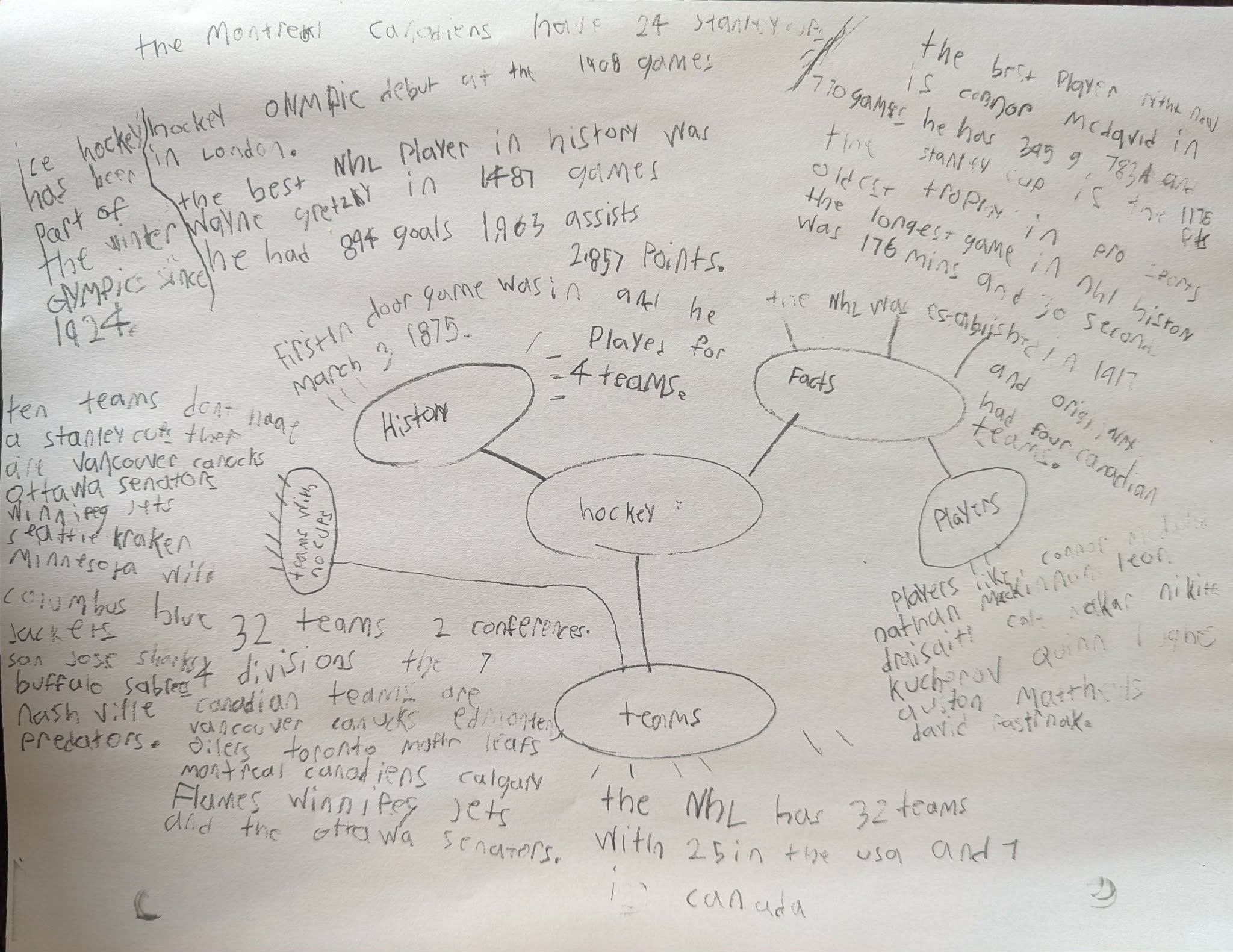
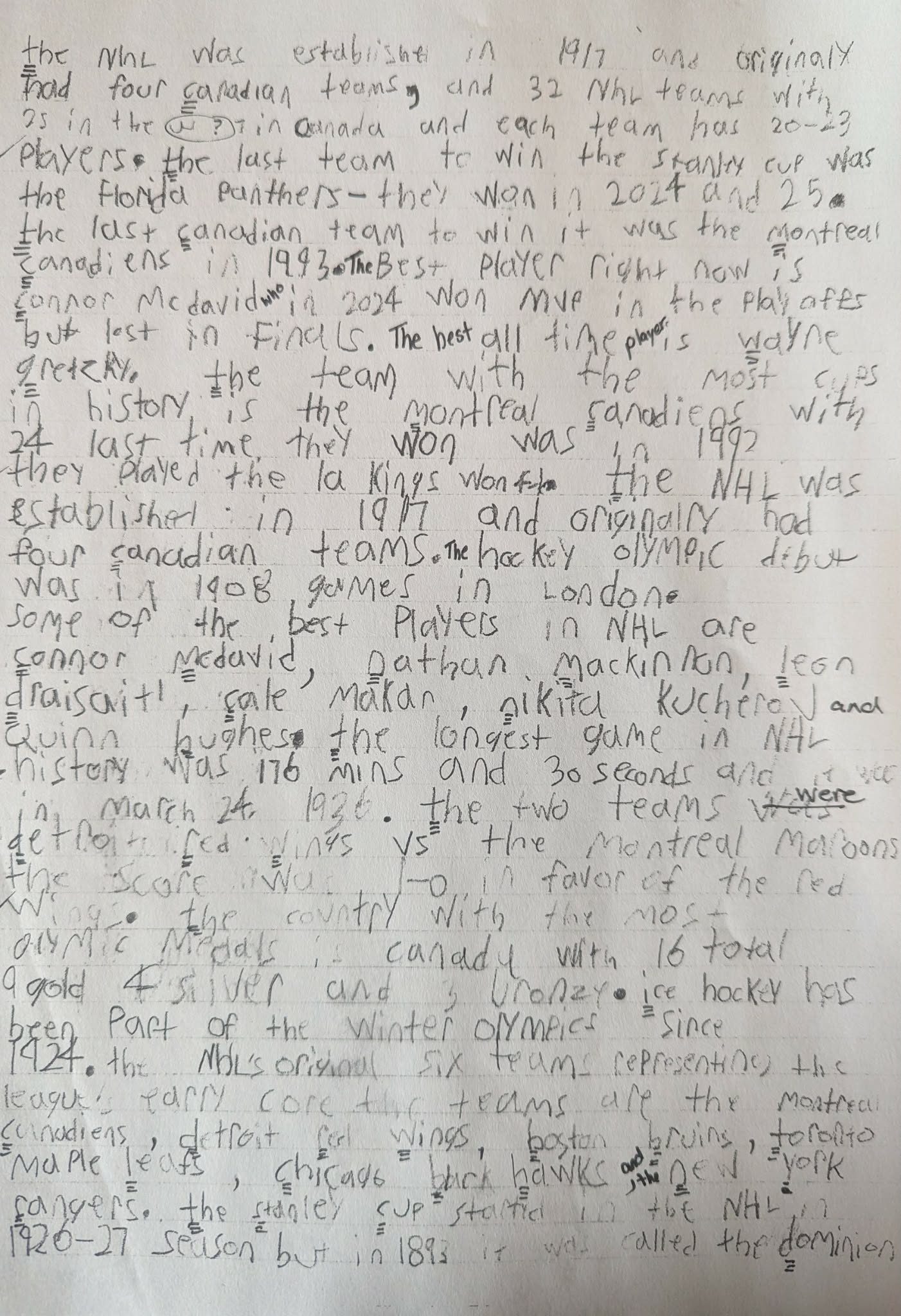
The photos shared are from a Grade 8 student who began the school year at an approximate Grade 3 reading and writing benchmark and who also had irregular school attendance. At the start of the year, this student struggled to read and write even a single simple sentence in English Language Arts. Through targeted literacy support, they progressed to completing a research mind map and ultimately writing an unformatted essay based on their research. Over the past eight months, this student has improved from a Grade 3 to a Grade 5 reading and writing benchmark level, and the included photos provide evidence of this growth.
Reflections/Advice: This inquiry reinforced that adolescent literacy development is highly complex and depends on the simultaneous strengthening of foundational skills (especially decoding and word recognition) and higher-level language comprehension. I learned that many middle school students benefit from explicit, systematic instruction in vocabulary, morphology, and reading fluency, and that these skills cannot be assumed to have been fully developed in earlier grades. I also learned that student engagement improves significantly when instruction is purposeful, scaffolded, and connected to student interests, and when classroom culture emphasizes safety, persistence, and normalizes mistakes as part of learning.
Moving forward, I plan to continue refining explicit literacy instruction, with a stronger focus on sustained decoding practice, structured vocabulary development, and consistent opportunities for guided and independent reading. I would also like to deepen the use of diagnostic assessment to more precisely identify student needs earlier in the year and to better tailor small-group interventions. In addition, I plan to further strengthen writing instruction by continuing to break tasks into manageable steps and embedding more frequent, low-stakes writing opportunities across the curriculum.
For schools undertaking similar work, my advice would be to prioritize consistent, school-wide literacy expectations and ensure that all teachers have access to practical training in foundational reading instruction, not just theoretical understanding. It is also essential to provide sustained access to diverse, high-interest texts and to embed literacy instruction across subject areas rather than isolating it within English classrooms. Finally, schools should invest in ongoing collaborative inquiry time so teachers can share strategies, analyze student data together, and adjust instruction in response to what students actually need.