
I. General Information
School Name: Pleasant Valley Elementary
School District: SD#68 Nanaimo-Ladysmith
Inquiry Team Members: Amanda Kiatipis – amanda.kiatipis@sd68.bc.ca
Marcy Boudreau – mboudreau@sd68.bc.ca
Kelly Inglis – kinglis@sd68.bc.ca
Taya Sklapsky – taya.sklapsky@sd68.bc.ca
Inquiry Team Contact Email: amanda.kiatipis@sd68.bc.ca
II. Inquiry Project Information
Type of Inquiry: NOIIE Case Study
Grade Levels Addressed Through Inquiry: Primary (K-3)
Curricular Areas Addressed: Language Arts – Literacy, Social Studies
Focus Addressed: Local Indigenous Knowledges, Literacy, Core competencies (for example, thinking, communication, personal and social), Land, Nature or Place-based learning
In one sentence, what was your focus for the year? Using local animals as symbols to represent the qualities of learners, focused on the core competencies to have students gain self-awareness of who they are as learners and focus on their strengths.
III. Spirals of Inquiry Details
Scanning: At the beginning, we always ask learners to name two adults in the school that believe they will be successful. Most students were able to do that, and most included previous teachers. There is clearly a strong connection between teachers and students at this school. The few students that found it difficult were discussed, and teachers focused on connecting with them over the year.
Since the animals as learner traits was introduced last year, many students had a good foundation in knowing them. When asked about the traits of each animal, many students could name at least one, few could name more than one. We also checked to see how much students knew about the significance of the animals in local Indigenous stories and beliefs. This knowledge was lower. They knew about Raven and about Eagle the most.
Focus: We selected this area because we know that our students are pretty confident and eager learners already, but we didn’t think that they could express that using oral and written language. By introducing one animal per month and focusing as a whole school on the learner traits of that animal, students had dedicated time to expand their language around what makes a strong learner and how they see themselves in these animals. We also have a low Indigenous population at our school, and we noticed that our students do not get as much experience and exposure to Indigenous culture and learning. By connecting the learner traits to the animals, we strived to pull Indigenous ways of knowing and learning into our everyday lessons. We focused on learning the hulquiminum words for the animals as well.
Hunch: Our hunch was that most of the teachers at this school have been there for a long time and have a set way of doing things, but we also know they are very strong teachers and open to trying new things. Three of us are new to the school and this was a great way to connect with the staff and create an experience that students could discuss across all grade levels.
New Professional Learning: 3 of us went to the Qualicum First Nations Early Years Conference and learned SO much about different practices. We purchased some books as well to support stories that go with each of the animals. We also borrowed pre-made kits from Qualicum First Nation as well so that we could incorporate hands-on learning in the classroom.
Taking Action:
– Every morning on the announcements the announcers say one trait about that months animal and ties the trait into learning.
– We have a monthly colouring contest for students to colour an Indigenous Artist’s drawing of the animal of the month.
– We have bins that teachers can borrow books and puppets from for each animal.
– We have monthly assemblies with a focus on the animal of the month and usually one or two divisions share at the assembly.
– Some classes did monthly reflections on the animal that is sent home.
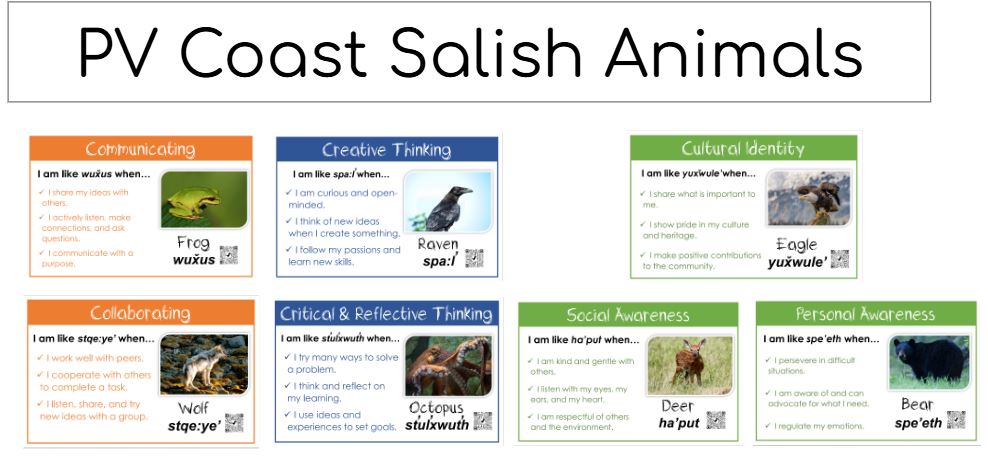
These are the signage we created for the traits and how they are connected to the core competencies.
Checking: We found that students were very excited and connected to the animals this year. Being that it was the second year, more teachers also felt more confident discussing the traits of each animal with their class. All students could easily say the hulquiminum name of each animal.
When we asked students to talk about themselves as learners during our second reporting period, some students referenced the animals without being prompted to. We also recently asked students to name two adults that believe they will be successful and the results were similar to the beginning of the year, but a few of the ones that couldn’t name any or only one were now able to include their current teacher. We felt that we did a great job at orally discussing the traits and connecting them to activities throughout the year.
Reflections/Advice: We learned that students are much better at talking about their own strengths when they can relate them to an animal they are familiar with. We also learned that they are keen to learn more facts about local Indigenous animals and the stories associated with them.
Next year, we plan to incorporate more writing reflections and hopefully get some of the older classes to participate more.