
I. General Information
School Name: Seaview Elementary
School District: SD#68 Nanaimo-Ladysmith
Inquiry Team Members: Sofia LaBounty: sofia.labounty@sd68.bc.ca, Lindsey Watford: lindsey.watford@sd68.bc.ca, Michael Biggs: mbiggs@sd68.bc.ca, Shaun Weighill: sweighill@sd68.bc.ca, Chris Johnson: cjohnson@sd68.bc.ca, Carene Booth: cbooth@sd68.bc.ca, Krista Endrizzi: kendrizzi@sd68.bc.ca, Rachel Stewart: rachel.stewart@sd68.bc.ca, Michelle Cowan: michelle.cowan@sd68.bc.ca, Lara Graaten: lgraaten@sd68.bc.ca
Inquiry Team Contact Email: sofia.labounty@sd68.bc.ca
II. Inquiry Project Information
Type of Inquiry: NOIIE Case Study
Grade Levels Addressed Through Inquiry: Primary (K-3), Intermediate (4-7)
Curricular Areas Addressed: Language Arts – Writing
Focus Addressed: Literacy
In one sentence, what was your focus for the year? Improve student confidence in writing.
III. Spirals of Inquiry Details
Scanning: Last fall, we surveyed grade 2-7 students the two key questions as part of the scanning process. Our findings showed the majority of our student population could identify two adults in their life that support them. Our second question focused on their feelings around writing and writing behaviours. This data helped us understand our students’ attitudes towards writing, and we gained insight into what types of writing activities our students enjoyed participating in and the level of confidence when writing.
Focus: As a staff, we felt that creative writing ability was on the decline in our student population, and we wanted to adjust our instruction to improve student confidence and ability in this area.
Hunch: We spent time looking through writing samples across the grades and discussing where on the proficiency scale our students placed. We had meaningful discussions about our teaching strategies and how student written output has been changing over time. Our hunch was developed from discussions about the lack of providing students with creative and imaginative experiences. As a staff, we became curious about strategies and teaching practices that could improve our student output.
New Professional Learning: Our staff dedicated a professional development day on writing. We revisited our students’ writing samples and explored the 6+ traits of writing. In grade groups, we discussed strategies and teaching practices at each grade level. We then examined writing samples highlighting the traits our students are still developing. The staff agreed that resources to support these traits would be beneficial, as well as revisiting our students’ writing in the fall to measure any success.
In addition to using the 6+ traits of writing resources, our staff learned about story workshop, specifically for the intermediate grades. Primary teachers are already familiar with story workshop, but it was new learning for intermediate teachers, as well as how students can benefit from using loose parts to incorporate a variety of topics/concepts in the curriculum. Story workshop in the intermediate grades supports writing instruction by giving students regular opportunities to plan, draft, revise, and share their ideas in a structured yet flexible environment. It builds independence and strengthens writing skills by integrating teacher mini-lessons, peer feedback, and authentic purposes for writing. The resources online were persuasive and staff are keen to incorporate story workshop in the intermediate grades.
Taking Action: Lead teachers explored resources online and gathered lesson plans with mentor texts to support each writing trait. With some additional funds provided, we purchased picture books and printed lesson plans for teaching staff to easily access and use in their practice. We agreed to keep these resources in clearly marked bins in the library for easy access. Any teacher can add resources to these bins.
We also put together a story workshop cart, so K-7 teachers can have access too.
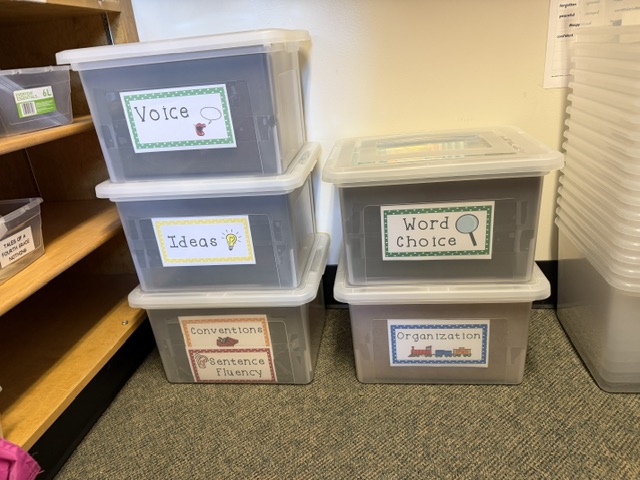
Bins stored in the library containing mentor texts and lesson plans for each writing trait.
Checking: Since gathering these resources were fairly time consuming, our staff has not been able to fully implement all traits of writing throughout the year. We plan to revisit the use of these bins and story workshop cart for regular use and refinement for the coming school year. We will be able to reflect on whether or not we made a difference in a year’s time.
Reflections/Advice: The staff enjoyed exploring the 6+ traits of writing as a support to improve writing. We believe it will be a useful tool because it breaks writing into clear parts, making it easier to understand. It helps students focus on specific areas, like ideas or organization, to improve their work. This approach also makes feedback more helpful and supports stronger overall writing skills.
We are looking forward to implementing these resources and would suggest for any school looking to do something similar, that it will take some time to put the resources together.