
I. General Information
School Name: Arden
School District: SD#71 Comox Valley
Inquiry Team Members: Katie.Arsenault: katie.arsenault@sd71.bc.ca, Leah Lloyd: leahlloyd@sd71.bc.ca, Michelle Honeysett: michelle.honeysett@sd71.bc.ca, Carlene Steeves: carlene.steeves@sd71.bc.ca
Inquiry Team Contact Email: katie.arsenault@sd71.bc.ca
II. Inquiry Project Information
Type of Inquiry: NOIIE Case Study
Grade Levels Addressed Through Inquiry: Primary (K-3)
Curricular Areas Addressed: Other: Social Emotional Learning
Focus Addressed: Core competencies (for example, thinking, communication, personal and social), Other: Social Emotional Learning
In one sentence, what was your focus for the year? We have noticed over the years that parents and students have had an increase in difficulty transitioning to kindergarten.
III. Spirals of Inquiry Details
Scanning: This is an extended spirals of inquiry project which has been an ongoing journey over several years, continually growing and evolving as each new discovery, question, and learning experience inspires us to expand and understand and add new ideas. Our main observation is that students and families are far more unsure than ever about transitioning to kindergarten. We wondered what was going on for our learners and their families? Through a collaborative process involving staff, families, and community members we can network to create a calm, supportive environment that helps ease anxieties and encourages everyone to feel safe, confident, and ready to learn.
Focus: Can we change some of our teaching practices or routines either before or during the school season, to better support our families and our learning community members? We hope that by changing some of our practices we can provide a supportive, safe, and encouraging learning environment. How are our students and families feeling about attending their first year of learning in kindergarten? What more can we do to support hope the early learners while keeping their social emotional well being at the forefront.
Hunch: We hoped that by providing multiple opportunities for families to engage, that we encourage relationships to grow and families and learners to feel less anxious about transitioning to kindergarten. We are hoping that by including them in various activities, they will feel more comfortable in the kindergarten setting. We assumed that families were receiving and reading e-mails that give information about the kindergarten year coming up. We assumed that parents have time off to join us during the day. We had a hunch that other community pre-kindergartens knew kindergarten transition information and passed on to future kindergartens.
New Professional Learning: Early Learning Years conference on October 24, 2025. Connecting with local ECE and early learning teachers. Joining our local PSA for early learners. Dr. Kimberly Schonert-Reichl work with SEL. As opportunities arise we will participate in teachings that relate to this topic. Collaborative conversations with school colleagues, district colleagues as well as different agencies.
Taking Action: We teach in a very collaborative environment as a trio. All of our kids are out students and we all teach each one of them in a collaborative capacity. Over the course of the last 3 years we have continued to make efforts to reach out in different ways to families of transitioning kindergarten children. This year we decided to pilot a no gradual entry kindergarten start. We started with full days on day one and if families required more time to transition, we were happy to provide a gradual entry option.
We reflected about what went well and what could be done differently. Together we brainstormed ideas that could help our future students and families feel more comfortable at school.
This was the second year that we had an earlier registration for kindergarten and instead of February it was in January. As the official district welcome to kindergarten date approached, we invited families to meet us once a week during our morning gathering in the outdoor classroom. Families were e-mailed and encouraged to join our land acknowledgment, our songs and stretches, and our daily forest walk. Many families joined us. We also extended this opportunity to our newly built on-site Boys and Girls club care centre. Unfortunately, for the care centre next door, the ratio and logistics restricted them from joining us.
As the year progressed, we had many opportunities to meet and greet our new to K families and by the time that the district welcome to kindergarten started, we had met all of our future families.
The night before our Welcome to K we had a parent session to meet just with parents and give them a tour of the school, our classrooms, and to answer any questions they were curious about. We gathered first in a circle formation to provide an opportunity to connect first. We shared what the shape of our day at school often looks like and had a visual calendar to refer to. We asked a reflective question ” What do you remember about kindergarten?” One we heard each voice in the circle, we moved in the outdoor classroom so families could get a sense of what our day begins like and then we visited all the kindergarten classrooms. We ended with an open group question and answer period at the end. We polled about another session and if timing early 3:00-4:30 or a after 5:00 pm time would be better for families.
The following early evening we had our Welcome to K sessions where we provide an open centre concept to visit all the important people to meet and areas in the school they will be attending. Our staff is very supportive and we have most staff paired or independently manning a station. Parents said they felt settled and could help guide their students from one place to another and also many of the parents had face to face conversations with us already so they were more comfortable with us as the future teachers. Kids had their standard bag and then we always provide a litter-less snack bag to model our garbage-less lunch, we provide little treasures in each classroom that adds to their standard bag and supports the curriculum they will experience.
A month later, we provided another special night for families. We had a scavenger hunt where families were given clues and then had to collect letters and then together as a family solve a word puzzle. Once families collected all letters and solved the puzzle, students were given a special nature explorer bag full of our curriculum supported and nature ambassador tools. There were a few outdoor/nature scavenger hunt papers, a pencil, a notebook, a magnifying glass, and a side bag to hold all the materials and a reference book. We also arranged for our City Bus to take kids for rides around the block with their families. We have 3 time frames they could participate in, they could participate as many times as they wished.
We continued to have our families join our Tuesday and Thursday walks and added a Wednesday family woods walk until the last week of school. We provided families an opportunity to join a K to play afternoon. We provided a weekly play hour in a rotation of our classrooms to have families have personal experience in all the classrooms and with all their future kindergarten teachers.
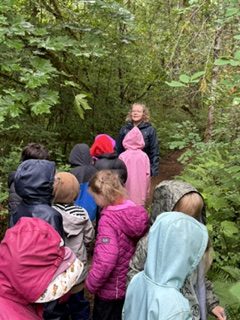
Woods walk in the forest behind Arden Elementary in the Comox Valley. Discovering nature with our curious learners.
The previous year we created a series of five mini video clips to share what our everyday at Kindergarten looked like. We broke the informative videos into five categories; shape of the day, who are we, building independence, transitions in school, and arrival and departures. We decided to send these video clips out in a scheduled manner so that families would have more communication from their teachers throughout the summer and be able to refer to videos as many times as needed.
This summer we will send out videos to our future kindergartens again, and we have also organized a meet and play at the playground on August 18.
Checking: This response is divided into two parts, one our Kindergarten’s transition to kindergarten this year, and two our future kindergarten’s. We were able to meet all of our registered families before the school year began. This year when students started kindergarten in September, we had very few kids and families that were having difficulties with the transition to kindergarten. I often heard parents in the first few weeks refer to pieces that were demonstrated in the video series we sent. Upon entering our classrooms, families would refer to our visual schedule with their children. Children were able to open, close, and organize their items for snack and lunch. Some children who were more nervous had transition plans set up before they started such as a comfort stuffy in their backpack, a family picture, or a goodbye routine. Children came prepared for the weather and most items were labelled with names. We observed that transitions to school this year were smoother than before.
For our future kindergarten’s we implemented all of the strategies we had used the previous year. We reflected and pondered what we put into action this year and did it work. As a collaborative team, we felt the intentional efforts and supports we had established did make a positive impact this year. Students and families arrived better prepared for the school year, resulting in smoother transitions and noticeably reduced anxiety. The proactive supports and consistent practices established previously have fostered greater confidence, familiarity, and readiness, creating a more positive and settled start for our learning community.
We are hopeful that our efforts will show significant results again this coming fall.
Reflections/Advice: We have learned that three years ago we were on the right track about making stronger connections with families. Families were needing more support about how to approach kindergarten, what they needed to know, what was expected and what could families do to help support a better transition into kindergarten. Demystifying the idea around kindergarten expectations, that printing your name and knowing their letters is a parent’s job, it is literally in our kindergarten curriculum to teach. Through this process, the importance of connection, relationships, communication, and time together was emphasized. Parents were so appreciative of the process and how approachable we were as teachers. Parents mentioned they were truly able to chat and reassure their children about what was to come and the importance of face to face connection.
As teachers, we will continue to use the videos we created to explain our program. Our district’s Early Years principal has encouraged us to use the concept of our videos and how we continue to reach out to families across the district as a model or as a jumping point for other programs or kindergarten teachers.