
I. General Information
School Name: Beach Grove Elementary
School District: SD#37 Delta
Inquiry Team Members: Josie Zahn: jzahn@deltaschools.ca, Angela Vaughan: avaughan@deltaschools.ca, Jacquie Von Schulmann: jvonschulmann@deltaschools.ca
Inquiry Team Contact Email: jzahn@deltaschools.ca
II. Inquiry Project Information
Type of Inquiry: NOIIE Case Study
Grade Levels Addressed Through Inquiry: Primary (K-3), Intermediate (4-7)
Curricular Areas Addressed: Language Arts – Literacy, Language Arts – Reading
Focus Addressed: Literacy
In one sentence, what was your focus for the year? Our school has been focused on collecting reading data and supporting all students in their reading progress.
III. Spirals of Inquiry Details
Scanning: Our school has been participating in collecting reading data as part of a district pilot. Coordinators in our district provided us with the data and how we could take further steps with our students in terms of supporting their reading progress. Teachers are feeling that classes are becoming more complex and providing small group targeted support is more challenging given all the diverse needs we are trying to meet.
Focus: Our school has been focused on collecting reading data and supporting all students in their reading progress. We are hoping that our reading data collection will help to inform our teaching to make sure we are helping students progress in their reading development. By providing smaller group, targeted instruction, we hope to be able to meet a wider range of needs.
Hunch: We wondered if trying a phonics skills camp where teachers took a different group (and smaller group) based on phonics needs would allow for more successful targeting of reading skills and meet more needs of the students.
New Professional Learning:
– Our district has been working on creating a website that enables teachers to select a specific phonics skill and plan instruction based on specific targeted needs: https://deltalearns.ca/elementaryliteracy/phonics
– Our district is using a reading data collection pilot: https://deltalearns.ca/elementaryliteracy/assessment-2/
– We are also doing a book club on the book “Know Better, Do Better” by David & Meredith Liben which focuses on comprehension skills and vocabulary to further enhance our professional learning about teaching reading.
– Through Lunch and Learns, collaboration time, and our professional learning days, our school is focused on learning about effective teaching strategies to support our readers.
Taking Action: Grade 1-3/4 teachers and LST teachers worked together on “phonics skills camp” 2-3x a week. Students were placed in a group that focused on their area of phonics need (as assessed on our district reading data: https://deltalearns.ca/elementaryliteracy/new-reading-data/ ) for approx. 6 weeks at a time. During this time, the teacher would do a short lesson about the particular skill and then students would play games or work with the teacher on an activity focused on practicing that skill.
Some games and activities were from our district Phonics playbook: https://docs.google.com/presentation/d/1gjgQDPS-VftwOWq8DTnPLJ6vm_bt_PpZbkGByMrt9As/edit?slide=id.g7e7af16d38_0_0#slide=id.g7e7af16d38_0_0 . Teachers prepared some of these activities and had bins ready to go focused on each phonic skill.
Our K-7 teachers also met for a series of Lunch and Learns to focus on the book: “Know Better, Do Better” comprehension (https://education.scholastic.ca/en/9781546113874-edu-ca.html). Our Literacy Teacher Coordinator was able to come to this series and presented useful information and ideas for teachers to try in their classroom.
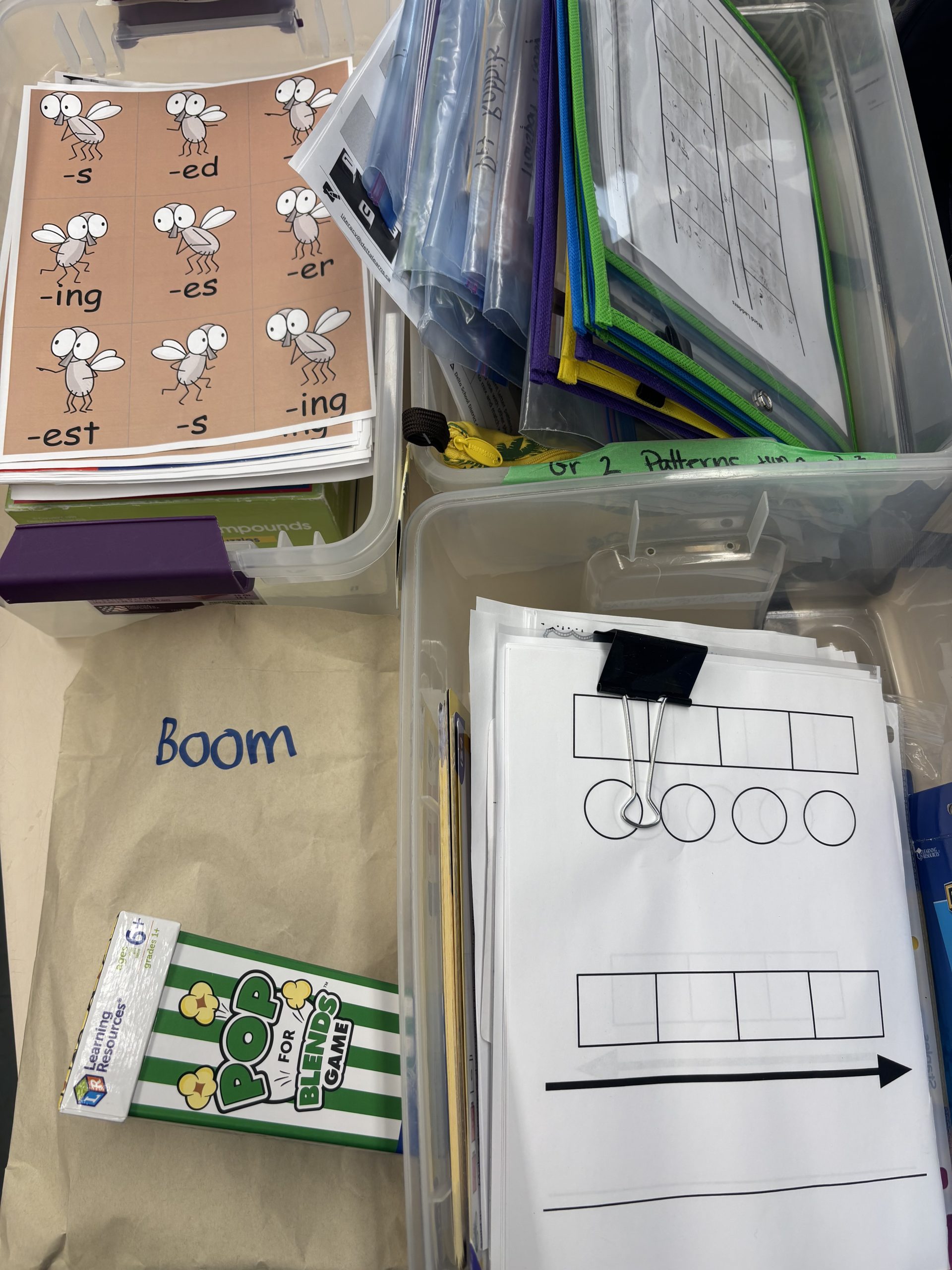
This is a photo of one of our “phonics bins”. We had many prepared with activities, books and games focused on specific phonics skills.
Checking: We were able to check progress each term as our district required teachers to collect reading data. The district-wide literacy assessment included the Orf, phonemic awareness and phonics. Based on this data, we were able to move students to target different areas of phonics needs. We also met together for lunch and learns to reflect on how things were going and found that it was beneficial to have slightly longer lessons to focus on clearly teaching the skill before moving into games or other practice activities.
For our book club, as part of our collaboration time, teachers had an opportunity to meet once to discuss or prepare activities to try with their classes, as well as time to reflect on this during the lunch and learns (approx. 6 over 2 terms).
Reflections/Advice: Continuing on the theme of learning takes patience and time, we are trying to remember to keep the scale small and then to build from there. The Phonics skills camp was more complex than we anticipated with many moving parts. We wanted this to be easy for teachers to implement, so we took some time to put together bins for each phonics skill so they were ready to grab and go. Teachers added to these over the year and we now have a great selection of games and activities in our teacher prep room for all to use. Other struggles we had were with people planning field trips, TTOC shortages so non-enrolling teachers not being covered, some groups being quite large (i.e. 18 students) which defeated the purpose of the small group skills camp, support for students with special needs who may need to go to another space in the school that was unfamiliar, etc. We also had some teachers prefer to become less involved later in the year, needing the time for scheduling other priorities which left us with only the Gr.1 and 2 groups for the final 2 terms. This actually worked out well as we were able to get the group sizes down to 12 or less with the help of our LST teachers. We found 6-12 students was ideal.
For our book club, the information tended to be more useful to our intermediate teachers, but we had many teachers able to take away learning and activities for their classes. The time frame was quite quick as we didn’t begin this until term 2, so it would have been nice to have a little more time with this book.
We are going to continue with our phonics skills camp again, but only Grade 1 and 2 classes, as well as LST Teachers, for September 2026. We are excited to see where this takes us and what the data will tell us about how this is supporting our students.