
I. General Information
School Name: Conrad Elementary
School District: SD#52 Prince Rupert
Inquiry Team Members: Lisa Scherr: lisa.scherr@sd52.bc.ca, Sarah Kavalec: sarah.kavalec@sd52.bc.ca, Jean Marogna: jean.marogna@sd52.bc.ca
Inquiry Team Contact Email: lisa.scherr@sd52.bc.ca
II. Inquiry Project Information
Type of Inquiry: NOIIE Case Study
Grade Levels Addressed Through Inquiry: Primary (K-3)
Curricular Areas Addressed: Applied Design, skills & Technology, Language Arts – Oral Language, Physical & Health Education, Science, Social Studies
Focus Addressed: Local Indigenous Knowledges, Core competencies (for example, thinking, communication, personal and social), Land, Nature or Place-based learning, Self-regulation
In one sentence, what was your focus for the year? Building relationships through forest play and a sense of place, creating rules about play and connecting to local Tsimshian culture.
III. Spirals of Inquiry Details
Scanning: We have observed students using the forest space and developing their own rules about play. Many students were unable to initiate play independently. Students have difficulty with balance and natural terrain. Many students were hesitant to experience the forest on their own: they are uncertain how to move, what activities to try, and/or have fears about safety.
Focus: Building relationships through forest play and a sense of place.
Hunch: Students may not have had experiences prior to this. By providing them with an unstructured place, we think they will develop curiosity, creativity and a connection to the world around them by stepping outside the structures of the classroom and the school setting.
New Professional Learning: Children are learning to connect with the land and the world around them. This is also a way to connect with Indigenous pedagogies and ways of knowing. This provides hands-on learning (learning is holistic). Our team will probe further into learning about the benefits of risky-play for students and will increase communication to colleagues and families about these benefits. We will revisit the Early Learning Framework and Learning in the Primary Years documents to support our observations and encouragement of play in this setting.
Taking Action: Time and space for unstructured outdoor play was provided. Space and objects were left to the students to organize. This gives us the opportunity to make photo documentation, observations and note-taking when recording students in play. We are setting the stage for unstructured play.
Checking:
– Community is being built amongst the Kindergarten cohort.
– Play has deepened and students have a deeper comfort and sense of purposeful play, no longer needing prompting.
– Creative and imaginative play has increased. In our final days, all students were able to find something they were looking forward to.
– We are noticing an increase in play activities such as hunting, harvesting, fishing, and using natural materials to build in alignment with the seasonal activities of our local Indigenous Tsimshian Peoples.
– Students have taken on leadership roles and created their own games.
– Compassion and inclusion have also increased beyond what we are observing inside the school and on the playground.
– Many have developed confidence with physical movements and risk-taking. Students now navigate terrain with critical thinking and an increased range of movements.
– The forest stimulates the senses, and we have noticed this helps students self-regulate. Additionally, we have noticed an increase in compassion and positivity.
Reflections/Advice: We have noticed students have increased risky play. Our team is interested in furthering our learning about risky play and what is age appropriate, as well as how to talk to administration and promote this further within our school community including support staff (Common language that does not unintentionally promote fear: “Be careful”).
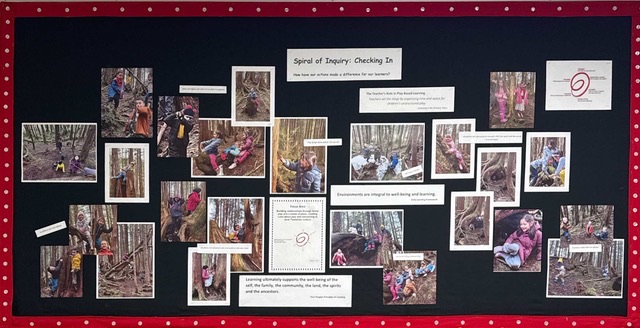

The photos are an example of our documentation board showing the stages of our spiral of inquiry. We displayed these photos for students and families to see throughout the year. Photos were taken by the Kindergarten team of Conrad School, School District 52.