
I. General Information
School Name: Mapes Elementary
School District: SD#91 Nechako Lakes
Inquiry Team Members: Kira Watson- kwatson@sd91.bc.ca
Candace Lawrence- clawrence@sd91.bc.ca
Jennifer MacDonald- jtmacdonald@sd91.bc.ca
Inquiry Team Contact Email: sdargis@sd91.bc.ca
II. Inquiry Project Information
Type of Inquiry: SRL Case Study
Grade Levels Addressed Through Inquiry: Primary (K-3), Intermediate (4-7)
Curricular Areas Addressed: Not applicable
Focus Addressed: Core competencies (for example, thinking, communication, personal and social), Self-regulation
In one sentence, what was your focus for the year? We worked in multi-age groupings to assist self-regulated learning through building strong personal and social relationships.
III. Spirals of Inquiry Details
Scanning: This will be our third year using our multi-aged groupings. We started our process by identifying that our learners could benefit from building their communication and collaboration skills. We conducted a school-wide project of making 4 multi-aged groupings to build these skills. Through these groups, we looked at local animals and completed skill-building activities in the forest. Last year, we were able to build on our communication and collaboration skills. We focused on building critical and creative thinking skills. We centered our activities around these skills. This year, we determined that the third layer was to build personal and social relationships using the skills we have been growing from the previous two years.
Focus: We wanted learners to develop a deeper understanding of one another. Our goal was for students to apply the skills they had built over the previous two years to form meaningful relationships with peers beyond their established friend groups. By expanding their connections, we hoped to foster a stronger sense of community, empathy, and belonging across the school.
Hunch: We noticed a growing sense of negativity toward the colour groups among some of our older students. As educators, we could see the significant progress learners had made over the previous two years. Communication skills were strengthened not only within the colour groups but also in other settings. We observed meaningful growth during playground interactions and transition times. This led us to wonder whether, although students may not have recognized their own growth as clearly as the adults did, they would still benefit from continued opportunities to develop and strengthen these skills.
New Professional Learning: Monthly Teacher collaboration planning sessions. This was a great time for our staff to reflect on how things were going and decide on the necessary steps to move forward. We used these times to plan and coordinate the coming group activities.
- Coyote’s Guide to Connecting with Nature – John Young. We used this for our forest activities.
- John Muir Laws Virtual Workshops – Learning in Nature. These were used for reflection activities.
- 4 Seasons of Indigenous Learning – Virtual Sessions and Season 1 – Foundational Knowledge.
Taking Action: We used two different approaches to help build relationships among our learners. Through conversations with our older students, we learned that it could be challenging to create activities that were engaging for all grade levels. As a result, we explored activities with our full Kindergarten–Grade 6 groups, as well as activities involving only the Grade 3–6 learners.
In our whole-school groups, we participated in activities such as morning forest walks followed by a school-wide pancake breakfast. During these walks, learners completed letter-unscrambling challenges as they travelled through the forest. Once finished, groups returned to the school and continued spending time together while sharing breakfast.
Within our K–6 groupings, we also completed seasonal STEAM-focused activities. During Halloween, the winter holidays, and Jump Rope for Heart, learners rotated through activity stations with their groups while teachers remained at designated stations. We noticed that this structure encouraged learners to build relationships by looking out for one another and helping each other complete the activities.
Our groups also constructed birdhouses. The Grade 4–6 class built their birdhouses first, which allowed them to develop an understanding of the necessary steps. Later, during our multi-aged groupings, the older buddies worked alongside their younger buddies to build one or two birdhouses together. This provided meaningful opportunities for leadership, mentorship, and collaboration.
In addition to these activities, we wanted to create opportunities for learners to contribute ideas based on their own understanding. To support this goal, we designed a collaborative project around the book Thomas’ Snowsuit. Each of our three classes read the same story but focused on different elements. The Kindergarten–Grade 2 class explored characters, with each learner selecting and colouring a character from the story. The Grade 2–3 class focused on setting, with learners recreating one of the story’s settings through drawing. Finally, the Grade 4–6 class examined the themes and underlying messages within the text.
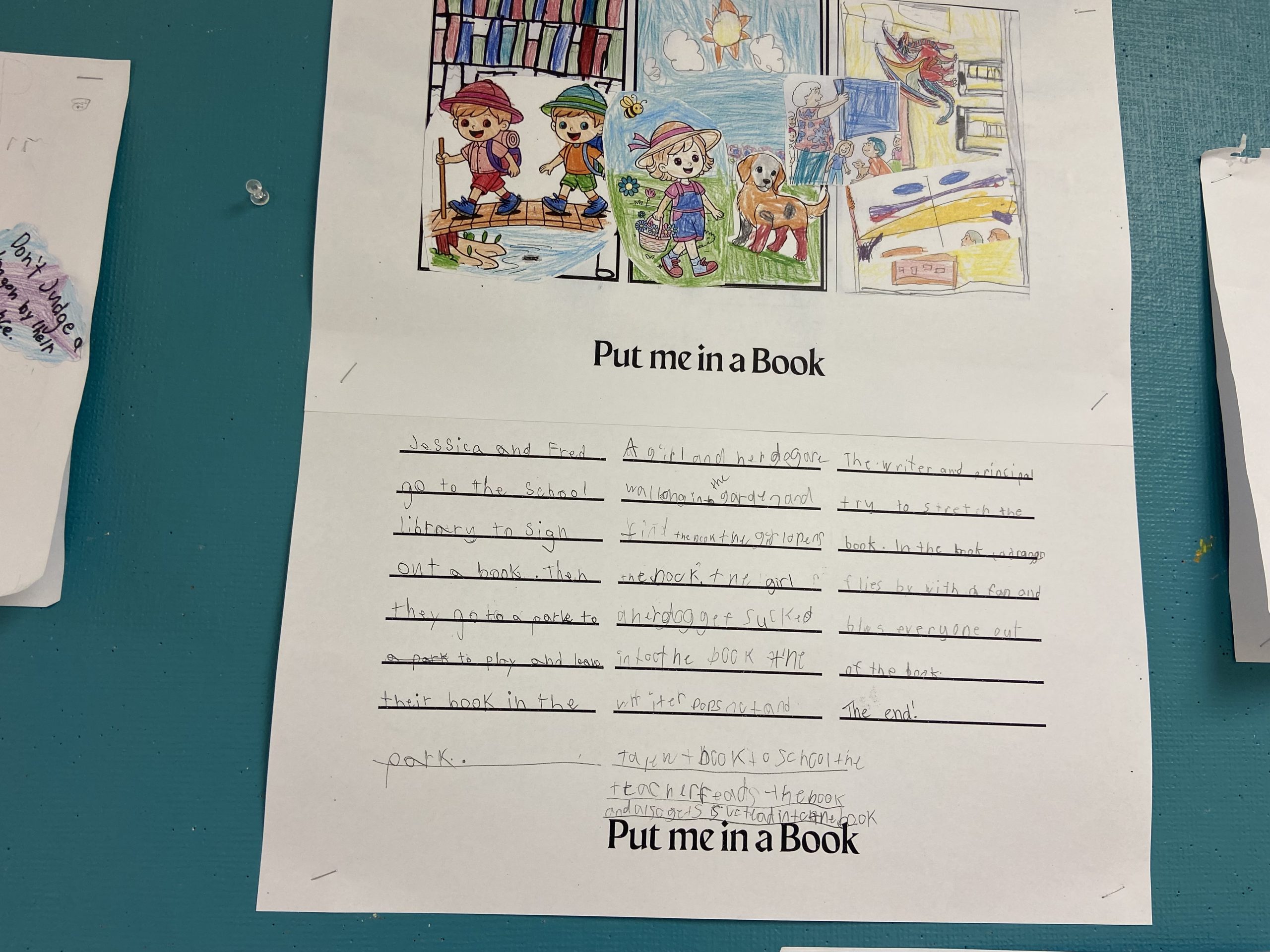
With each learner holding a different piece of the story, we used cards to create random groups that included students from each classroom. Each group had a character, a setting, and a collection of themes. Using these pieces of the puzzle, learners were challenged to create an original story together.
When we first attempted this activity, many learners experienced frustration and confusion. There were too many unknown variables at once—the task itself and the new groupings. While some groups found success, many struggled to understand what was being asked of them.
We revisited the activity later using a different story. Although we continued to use random groups of three, the task was now more familiar. This time, we saw exciting growth in both understanding and engagement. Learners were able to contribute their own ideas with greater confidence and collaborate more effectively.
We then adapted the activity for our colour groups. After reading a new story together, each group worked collaboratively to create a beginning, middle, and end using elements from the text. They developed three settings and incorporated characters from the book into their new story. Every learner could proudly say they had contributed to the final product, creating a strong sense of ownership and accomplishment.
Our most recent collaboration was with the Grade 8s from NVSS. Throughout the spring, our Grade 2/3 class collaborated with the Grade 8s on three different occasions. Each session, a new class of Grade 8s came to collaborate. The schedule for each session remained consistent. We met as a whole group to discuss the plan and safety. Using cards to make random partnerships, a Grade 8 buddy was partnered with a Grade 2/3 buddy. We then walked into our forest to clear the area for a learning centre. Once the spot was cleared, we completed a sit spot activity with our partners. The last activity was some form of creation activity that rotated throughout the sessions. Over the three sessions, we built animal sculptures, natural mandalas and gave trees clay faces. When the sessions were over, the entire group enjoyed a cool, sweet treat together.
Checking: Through our various activities, we observed exciting growth in our learners. They were excited to take on leadership roles and share personal experiences and ideas. In our colour groups, learners became quite comfortable working together and listening to one another’s ideas. We observed growth in learners of all ages sharing personal experiences with multi-aged peers in our organized groups and in moments such as recess. Our group as a whole has also demonstrated more patience and understanding for peers of all ages.
Reflections/Advice: Through this inquiry, we learned the importance of predictability when working to foster relationships. Through each of our collaborations and activities, we learned that if there are too many unpredictable variables, unknown groups, unknown activities, etc., groups demonstrated difficulty building relationships and sharing activities. We learned that if we have a variable that is predictable, learners demonstrated a stronger ability to build relationships and were more comfortable sharing their ideas. This can be a new activity, but with familiar groupings or familiar activities with unknown groupings sets our learners up for greater success to build relationships and use their communication skills.